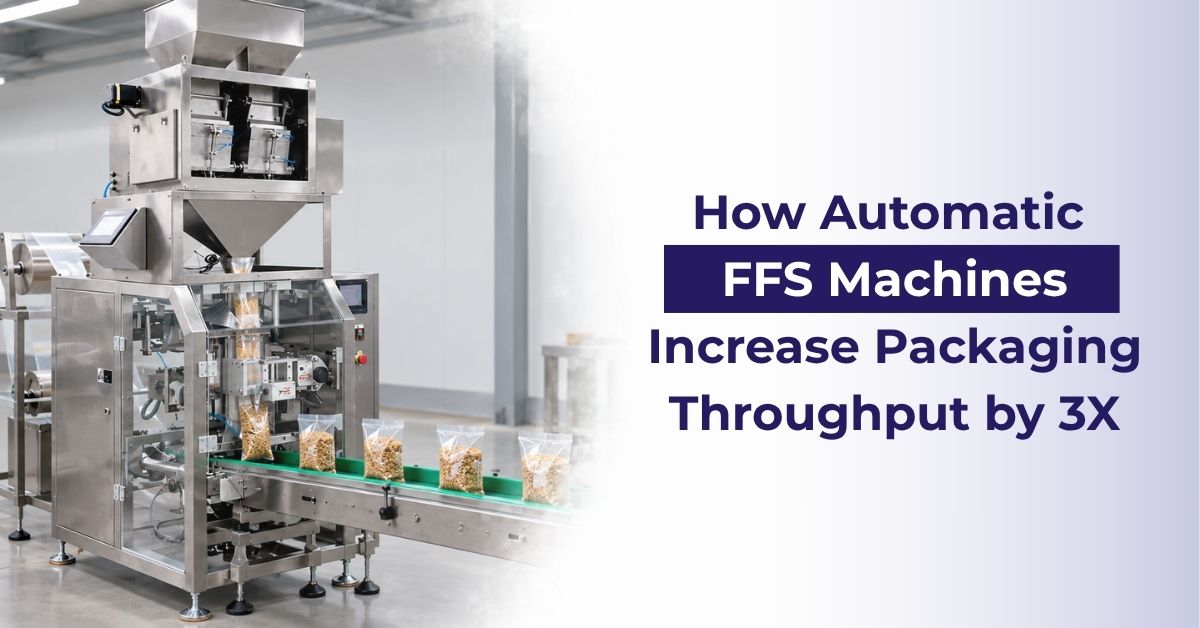
A common goal for any manufacturer is to have a production line that runs fast, smoothly, and efficiently, where every product that goes through various stages of manufacturing comes out packed, sealed, and ready to go. But if bottlenecks occur at the packaging station, it renders the entire point of an efficient production line moot. Packaging isn’t just about wrapping a product in plastic and calling it a day. This article explores how the right Form-Fill-Seal (FFS) machine can, in fact, transform your shop floor, enhancing efficiency and throughput.
Common Packaging Challenges That Limit Throughput
Even highly efficient production lines can struggle to achieve their desired output when packaging becomes a bottleneck. Some of the most common packaging challenges manufacturers face include:
Labour-intensive packaging: Manual handling and packaging operations increase labour requirements and can create inconsistencies during peak production periods.
Inconsistent pack weights: Variations in filling accuracy can lead to product giveaway, customer complaints, or regulatory issues.
Frequent machine stoppages: Interruptions caused by adjustments, maintenance requirements, or manual interventions can reduce overall line productivity.
Slow sealing operations: Delays in package sealing can create bottlenecks that prevent upstream processes from operating at full capacity.
Packaging material wastage: Inefficient use of packaging material can increase operational costs and impact profitability.
Difficulty scaling production: As demand grows, manual or semi-automatic packaging processes often struggle to keep pace with higher production volumes.
This is where automatic Form-Fill-Seal (FFS) machines can make a significant difference.
What is an Automatic FFS Machine?
FFS stands for Form-Fill-Seal. An FFS machine is a packaging solution that combines the steps of forming a plastic package, filling it, and sealing it shut, all in a single, continuous sequence.
By combining package formation, filling, and sealing into a single automated process, automatic FFS machines consequently eliminate several manual interventions that typically slow production lines. This allows manufacturers to significantly increase packaging throughput, reduce downtime between operations, and handle higher production volumes without expanding their workforce.
How Automatic FFS Machines Increase Packaging Throughput
An automatic FFS machine combines package formation, filling, and sealing into a single continuous process. By integrating multiple packaging steps into one machine, manufacturers can reduce manual interventions, streamline product flow, and minimize downtime between operations.
This helps improve:
- Packaging throughput
- Equipment utilization
- Production consistency
- Labour productivity
For example: A plastics granules manufacturer aims to pack 4500 bags a day.
With multiple operators, when the packaging segment of the manufacturing unit is run manually, labour costs go up, production may not be as consistent, and the process is susceptible to manual errors.
If the process needs four operators, each with a ₹15,000 salary, this means:
4 x 15,000 = ₹60,000
Together, these operators would have to try to pack about 500 bags in an hour, but this comes with the risk of errors and inconsistencies along the way.
On the other hand, when this line is integrated with an automatic FFS machine it results in:
One machine operator with ₹15,000 salary
Fully automated package forming, filling, and sealing in one go, so that it barely leaves a chance for manual errors and product inconsistencies.
Types of Automatic FFS Machines
Automatic FFS machines occur in different orientations depending on the manufacturer’s demand and shop floor requirements:
- Vertical FFS machines (VFFS)
- Horizontal FFS machines (HFFS)
Manufacturers looking for a packaging machine generally consider the FFS machine family to integrate with their production line. They then choose the orientation based on the space and setup they have for their product.
Vertical Form-Fill-Seal
As the name suggests, the products move from top to bottom in this variant, getting packaged along the way. Gravity plays a key role here, and that’s why this variant is more popular among manufacturers with free-flowing products.
Horizontal Form-Fill-Seal
In this variant, the film moves sideways to form into packages, which are filled and sealed. Generally, HFFS machines are used for products that are fragile, shaped, or need to stay in a certain orientation across the production line.
Why Opt for an FFS Machine for Manufacturing?
One clear reason why manufacturers gravitate toward automatic FFS machines is that it automates most of the packaging process. However, FFS machines offer several other perks that boost shop-floor efficiency and reduce manual errors as well.
Reduced costs: The machine forms its own packages with rolls of plastic film, instead of using pre-made pouches. Therefore, it eliminates the hassle of procuring pre-made packaging, and manufacturers can optimize material usage, hence cutting down on costs.
High-speed operations: Vertical FFS machines like the Prompt AutoPackPro can pack up to 3,600 packs every hour, with near-perfect accuracy every cycle. Such machines can also consistently push out packages weighing anywhere between 50 g and 1 kg.
Highly customizable: Depending on the end product, automatic FFS machines can generally be customized to accommodate different weights. For instance, the Prompt AutoPackPro is designed to handle any type of granular products, be it rice, millet, beans, sugar, tea, or other similar products.
Increased throughput: When the machine is faster and more efficient than manual processes, it is able to produce an increased number of packages.
Reduced Downtime: Because forming, filling, and sealing occur within a single integrated system, automatic FFS machines help reduce the number of manual interventions required during packaging. This contributes to smoother operations and fewer production interruptions.
Enhanced equipment efficiency: Packaging equipment often determines the maximum achievable throughput of a production line. By increasing packaging speed and consistency, automatic FFS machines help manufacturers improve the utilization of upstream production assets.
How to Choose the Right FFS Machine?
Apart from their orientation, FFS machines also come in different variants depending on the format of packaging. Since manufacturers would then have a plethora of options to choose from, here are some parameters that producers could use to make informed decisions:
Desired Output: Automatic FFS machines can vary based on the number of pouches/packets a manufacturer aims to produce in each batch.
Material Compatibility: Manufacturers may require a specific packaging material for their end product. This could include biodegradable materials, laminates, foil, and more. The FFS machine must be compatible with it.
Shop floor Footprint: Certain shop floors may not have the required space to accommodate a larger FFS machine. In that case, manufacturers could opt for a smaller or a vertical variant like the Prompt AutoPackPro.
Packaging bottlenecks shouldn’t limit your production capacity.
Connect with our team to discover how Prompt’s packaging solutions can streamline your packaging process and improve shop-floor efficiency.
Frequently Asked Questions
An FFS (Form-Fill-Seal) machine is an automated packaging system that forms a package from a roll of film, fills it with product, and seals it in a single continuous process.
FFS machines are widely used in industries such as food processing, agriculture, animal feed, fertilizers, chemicals, pharmaceuticals, and consumer goods packaging.
A Vertical Form-Fill-Seal (VFFS) machine packages products using a top-to-bottom process and is commonly used for free-flowing products. A Horizontal Form-Fill-Seal (HFFS) machine uses a side-to-side process and is often used for fragile or shape-sensitive products.
Yes. FFS machines create packages from rolls of film, eliminating the need for pre-made pouches. This can reduce packaging material costs and improve material utilization.
By automating package formation, filling, and sealing, FFS machines reduce the need for manual handling and repetitive packaging tasks, improving efficiency and reducing human error.
Prompt AutoPackPro is designed to package a range of products across different weight categories while maintaining high-speed operation and packaging accuracy.
