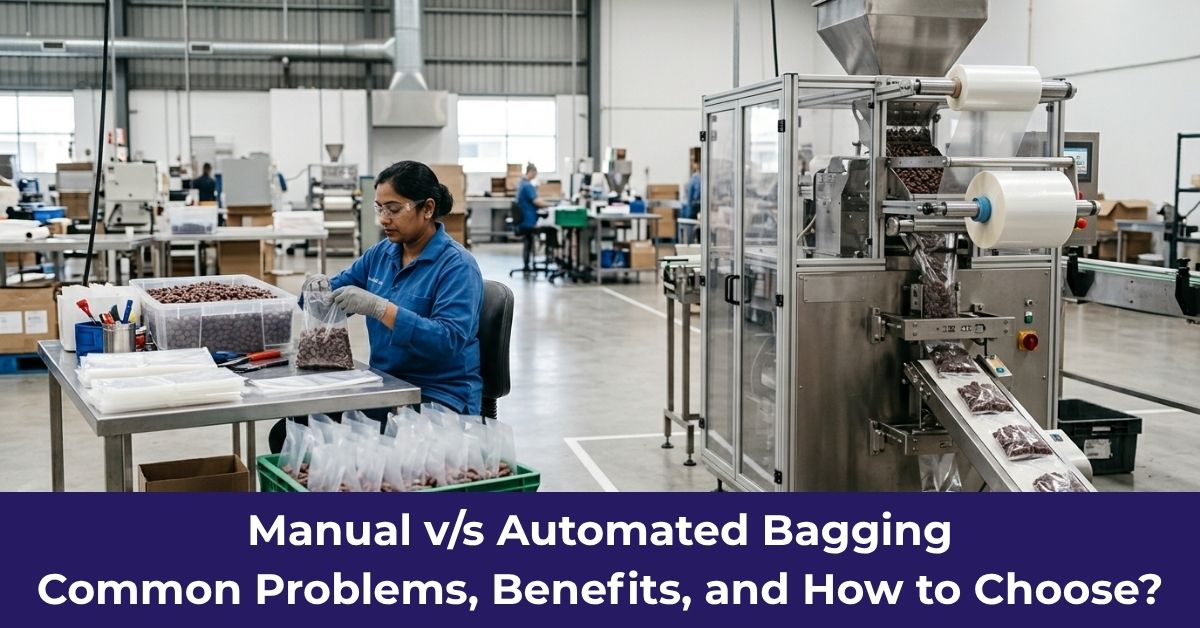
Every thriving business is on a constant quest to streamline operations and protect its bottom line. This journey often leads to crucial choices about which technologies to bring onto the shop floor, especially in the final stages of production. For manufacturers in the packaging industry, the decision between manual methods and automatic bagging machines is a pivotal one, shaped by the size and rhythm of their operations.
What Does Manual Bagging Involve?
This type of packaging heavily depends on manual labour and involves packaging primarily by hand. It involves little to no automation throughout the process. Generally, this is common among small businesses, start-ups, low-volume producers, cottage industries, and businesses that produce highly customized products.
How does Automated Bagging Work?
Automated bagging, in contrast, requires little human involvement beyond operating the machine. Some machines even create their own bags, fill them with product, and seal them for shipping. This method is a favourite among large-scale producers and manufacturers of items like food grains and plastic granules.
Comparing: Manual v/s Automated Bagging
| Key Aspects | Manual Bagging | Automated Bagging |
| Efficiency | Low-speed operations prone to human errors | High-speed near-accurate operations |
| Consistency | Often involves overfilling and inconsistent weighing | Highly consistent packaging |
| Initial Investment | Low initial cost | High initial cost |
| Long-term Investment | Higher labour-related operating costs over time | Lower cost per bag at higher production volumes |
| Downtime and Maintenance | Downtime depends on the staff, but maintaining manual machines may be simpler | Downtime is minimal with regular maintenance, but requires skilled technicians |
| Operational Flexibility | Ideal for businesses with evolving product lines | Ideal for businesses with large-scale production of uniform goods |
| Packaging Waste | Higher | Lower |
Pros and Cons – Manual Bagging: Manual bagging comes with a low upfront cost and easily adapts to businesses that need flexibility. However, expenses can pile up over time. The process is slower and more susceptible to mistakes, making it less ideal for manufacturers aiming for consistent, uniform products.
Pros and Cons – Automated Bagging: Automatic bagging machines stand out for their speed and efficiency, especially with solutions like Prompt PackEasy, which can pack 8-17 bags per minute. It delivers reliable consistency and accuracy, making it perfect for producing similar products at scale. They also apply precise filling controls that help prevent overfilling, reducing product losses and improving profitability. However, the upfront investment can be steep, and these machines are not designed for businesses that require frequent changes or flexibility.
When Must One Choose Manual Bagging?
Manual bagging has its own set of advantages and disadvantages. While it may not be suitable for manufacturers looking to produce uniform and consistent articles, it is a relevant choice in some cases.
For manufacturers launching a new venture and eager to start production without the burden of expensive machinery, manual bagging offers an affordable entry point. It also shines on production lines that require flexibility in products and packaging sizes. Unlike rigid machines designed for uniform output, skilled workers can quickly adapt to different products, making manual bagging especially valuable for customized or handmade goods.
When is the Right Time to Switch to Automated Bagging?
Automated bagging is a smart move for manufacturers chasing uniformity in large-scale operations. However, if producers already have a well-established team and want to grow, there are a few signs to watch for before bringing automation into their packaging process.
After relying on manual bagging for some time, businesses may notice operations slowing down and packaging becoming less consistent. This can lead to trouble keeping up with market demand, rising order backlogs, and more frequent packaging mistakes.
If you spot these warning signs in your operations, it could be the perfect moment to bring an automatic bagging machine like the Prompt PackEasy onto your shop floor.
Choosing the Right Bagging Machine
Packaging operations in a manufacturing facility do not have to be fully manual or fully automated. Producers can choose semi-automatic packaging solutions as a middle ground. Depending on production priorities and requirements, manufacturers can opt for any of the three bagging solutions.
For manufacturers handling granular products like grains or plastic granules, hitting the right weight in every bag is critical. Automatic bagging machines such as the Prompt PackEasy are flexible across different weight ranges, adapting to the size of the final product. With a self-optimizing program that precisely manages material flow and speed, the system also generates reports via USB for easy analysis, giving your operations a competitive edge.
Ultimately, the best choice comes down to your operation’s scale, product type, and production priorities. Curious about how Prompt PackEasy could fit into your workflow? Schedule a call with our experts to find out more.
Frequently Asked Questions
An automatic bagging machine is a packaging system that automatically fills, weighs, and seals bags with minimal human intervention.
Manual bagging relies on human operators to fill and package products, while automated bagging uses machinery and self-optimizing programs to do the same.
Automated bagging systems like the Prompt PackEasy improve packaging speed, accuracy, consistency in production, and productivity.
Manual bagging can lead to slower production rates, inconsistent package weights, higher labour requirements, increased packaging errors, worker fatigue, and difficulty scaling operations as demand grows.
Manufacturers should evaluate product type, production volume, bag sizes, desired automation level, weighing accuracy, maintenance requirements, scalability, and return on investment before choosing a bagging solution.
Production speeds vary depending on the machine and product type. However, Prompt PackEasy can pack 8-17 bags per minute, depending on the variant and the final product weight.
