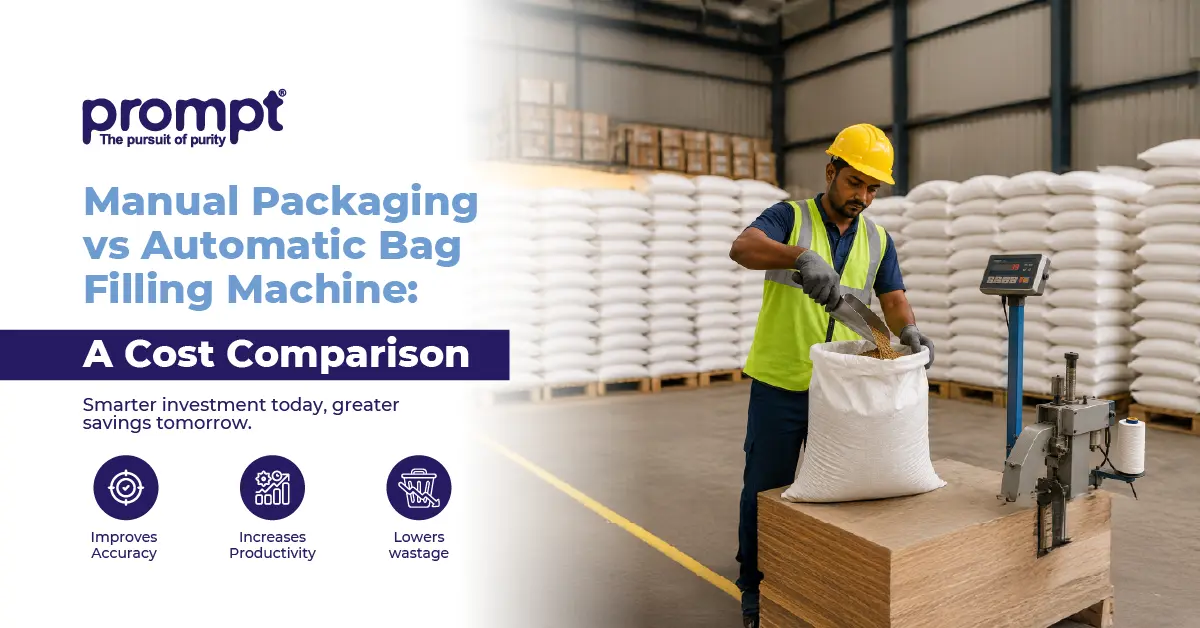
Many grain manufacturers continue to rely on manual packaging because it appears to be the more affordable option. The investment required for an automatic bag-filling machine often makes manufacturers question whether automation is worth the cost.
However, the true cost of packaging extends far beyond labour expenses. Product giveaway, packaging speed, labour dependency, and operational efficiency all have a direct impact on profitability. As production volumes increase, these hidden costs can significantly affect the overall cost of operations.
This raises an important question: Is manual packaging really more cost-effective, or can an automatic bag-filling machine deliver better long-term value?
Why Packaging Costs More Than You Think
When manufacturers evaluate packaging costs, labour expenses are usually the most visible component. However, the actual cost of manual packaging often extends much further.
Product Giveaway
To avoid underweight bags, operators often add slightly more product during filling. While a few extra grams may seem small, the losses can add up quickly over thousands of bags.
Inconsistent Bag Weights
Manual packaging often produces different results between operators and shifts. These variations can affect product consistency, customer trust, and compliance with declared package weights.
Lower Packaging Speed
The output of a manual packaging line depends heavily on operator efficiency and manpower availability. Labour shortages or reduced productivity can slow down packaging operations and delay dispatch schedules.
Higher Labour Dependency
As production volumes increase, manufacturers often need to add more operators to maintain packaging output. This increases labour dependency and recurring operational costs year after year.
Limited Production Visibility
Many manual packaging processes provide limited visibility into output, efficiency, and material usage. Without reliable production data, it becomes difficult to identify losses and areas for improvement.
The differences between manual and automated packaging become more evident when key operational parameters are compared side by side.
Manual Packaging vs Automatic Bag Filling Machine
| Parameter | Manual Packaging | Automatic Bag Filling Machine |
| Labour Requirement | High | Lower |
| Packaging Speed | Operator dependent | Consistent |
| Weighing Accuracy | Variable | High |
| Product Giveaway | Higher | Lower |
| Weight Consistency | Variable | Consistent |
| Production Visibility | Limited | Better |
| Scalability | Difficult | Easier |
| Long-Term Operating Cost | Higher | Lower |
While actual savings may vary based on production volume, product value, and operating conditions, The example below shows how hidden packaging costs can add up over time.
A Practical Cost Comparison Example
Consider a rice mill or pulse processing plant packaging 5,000 bags per day.
Labour Cost Comparison
Manual Packaging
- 4 operators
- Average salary: ₹18,000 per month
Annual labour cost:
- 4 × ₹18,000 × 12 = ₹8.64 lakh per year
Automated Packaging
- 1 operator
- Average salary: ₹18,000 per month
Annual labour cost:
- 1 × ₹18,000 × 12 = ₹2.16 lakh per year
Annual Labour Saving
- ₹8.64 lakh – ₹2.16 lakh = ₹6.48 lakh per year
Product Giveaway Comparison
Assume manual packaging results in an average product giveaway of 30 grams per 50 kg bag.
Daily production:
- 5,000 bags
- 30 grams giveaway per bag
Total giveaway:
- 150 kg per day
- 45 tonnes per year (300 working days)
Assuming a product value of ₹35 per kg:
- 45,000 kg × ₹35 = ₹15.75 lakh annual product loss
| Average Giveaway | Daily Loss (5,000 Bags) | Annual Loss (300 Days) | Value @ ₹35/kg |
| 30 g/bag | 150 kg | 45 tonnes | ₹15.75 lakh |
| 40 g/bag | 200 kg | 60 tonnes | ₹21.00 lakh |
| 50 g/bag | 250 kg | 75 tonnes | ₹26.25 lakh |
Total Potential Saving
| Source of Saving | Annual Saving |
| Labour Reduction | ₹6.48 lakh |
| Product Giveaway Reduction | ₹15.75 lakh |
| Total Potential Saving | ₹22.23 lakh |
This example demonstrates how even small improvements in packaging accuracy and labour efficiency can generate substantial annual savings.
When Does Automation Make Financial Sense?
An automatic bag-filling machine becomes a practical investment when manufacturers experience:
- Increasing production volumes
- Labour shortages
- Rising workforce costs
- Product giveaway concerns
- Multiple production shifts
- Future expansion plans
When these challenges begin affecting productivity and profitability, automation often becomes more cost-effective than continuously adding manpower.
How Prompt PackEasy Helps Reduce Packaging Costs
Prompt PackEasy is designed to help grain manufacturers reduce the hidden costs associated with manual packaging. By automating weighing, filling, and bag-closing operations, it helps improve packaging accuracy, reduce product giveaway, and increase packaging output while lowering dependence on manpower.
Key benefits include:
- Consistent bag weights for reduced product giveaway
- Higher packaging output to support growing production volumes
- Lower labour dependency through automated operation
- Integrated weighing, filling, stitching, and sealing in a single solution
- Better visibility into packaging performance through production reports
- Reliable performance for grains, pulses, seeds, fertilizers, animal feed, and other free-flowing products
Conclusion
While manual packaging may appear economical initially, the hidden costs associated with labour dependency, product giveaway, and lower productivity can significantly impact profitability over time. As production volumes grow, manufacturers need packaging operations that can scale efficiently without continuously increasing manpower and operating costs. The real question is not how much an automatic bag-filling machine costs, but how much manual packaging is costing your business every year.
